

EDspaces 2026 Call for Presentations
From real-world outcomes to emerging ideas, we’re inviting voices from across the learning-environment ecosystem to help shape what’s next. Submit Your Proposal
Learning does not happen in isolation. It is shaped by the physical environments students and educators inhabit each day, the systems that ensure comfort and safety, and the operational and maintenance decisions that sustain schools over time. Together, these elements create a learning ecosystem—one in which space is not merely a backdrop, but an active force influencing educational experiences and outcomes.
At EDspaces 2026, we invite presentations, workshops, and panels that strengthen and reimagine this learning ecosystem in alignment with our theme: Where Spaces Shape Learning.
All submissions due by March 31
Session Tracks
Across four focused tracks, EDspaces examines how physical space and operational strategy influence pedagogy, human experience, implementation, and future readiness —from vision to reality, and from evidence to impact.
- Track 1: Learning Spaces, Reimagined — Evolving physical spaces shaping the future of learning
- Track 2: Designing for the Human Experience — Wellbeing, inclusion, safety, and human performance
- Track 3: From Vision to Reality — Planning, funding, delivery, operations, and safety
- Track 4: Evidence, Impact & the Future of Practice — Research, systems, sustainability, and accountability
As learning has evolved, so too have the physical spaces that support it. This track explores how learning spaces within the broader learning ecosystem are reshaping instructional models, learner experience, and educational outcomes. Sessions should examine the relationship between pedagogy and physical space, recognizing that learning is influenced by a connected network of environments and systems across a school. While pedagogically focused, this track welcomes perspectives that address learning-support spaces and environmental conditions that directly impact teaching and learning.
We are seeking sessions that explore:
-
Future-focused learning models (project-based, experiential, SEL, interdisciplinary learning)
-
How physical space influences teaching and learning practices
-
Student agency, engagement, and ownership supported through space
-
District or school transformation stories driven by spatial change
-
Post-occupancy insights connecting physical space to learning outcomes
-
Learning-support spaces that enable education across the learning ecosystem
Effective learning ecosystems support the whole human — physically, cognitively, emotionally, and socially. This track centers on inclusive, sensory-aware, and wellness-driven design across learning spaces and the physical environments that support students, educators, and staff. Sessions should demonstrate how thoughtful physical space design promotes wellbeing, supports neurodiversity, and integrates physical safety in ways that enable people to feel secure, supported, and able to perform at their best.
We are seeking sessions that explore:
-
Neurodiverse and inclusive design strategies
-
Sensory environments (acoustics, lighting, materiality, movement)
-
Physical safety and Safe-by-Design approaches
-
Wellness, trauma-informed, and emotionally supportive spaces
-
Cognitive load, attention, and human performance
-
Universal design across learning and support spaces
Bold ideas only matter if they can be implemented. This track focuses on the processes and decisions that shape the physical learning ecosystem, and represents a primary point of engagement for facilities, operations, and procurement professionals. Sessions examine how planning, funding, design, construction, procurement, operations, and physical safety considerations intersect to bring learning ecosystems to life and sustain them over time.
We are seeking sessions that explore:
-
Capital planning, bond strategy, and funding equity
-
Renovation, modernization, and adaptive reuse
-
Design and project management lessons learned
-
Procurement strategies and partnership models
-
Facility operations that support learning and performance
-
Integrating physical safety into planning, design, and daily operations
This track bridges education and facilities by focusing on performance, systems, and long-term impact across the learning ecosystem. Sessions examine how research, data, technology, building systems, and lifecycle thinking inform better decisions related to physical space and future readiness. This track is especially relevant to audiences engaged in IAQ, energy performance, sustainability, resilience, and building systems, while maintaining a strong connection to educational outcomes and accountability
We are seeking sessions that explore:
-
Evidence-based design and measurement
-
AI, data, and emerging technologies in learning ecosystems
-
Sustainability, resilience, and lifecycle thinking
-
Environmental performance (IAQ, acoustics, materials, energy)
-
Policy, standards, and accountability frameworks
Session Formats/Delivery
Sessions are delivered through presentations, workshops and moderated panels and are designed for district and school leaders, educators, architects and designers, facilities and operations professionals, and industry partners committed to advancing education through intentional, holistic learning ecosystems.
Most sessions are 60 minutes in length. If your topic requires more time, you may request 90 minutes, but those slots are subject to availability.
Presentations are limited to a maximium of four (4) speakers, including a moderator. Panels should include at least one presenter from an educational facility. Speakers may submit more than one session for consideration by submitting each separately.
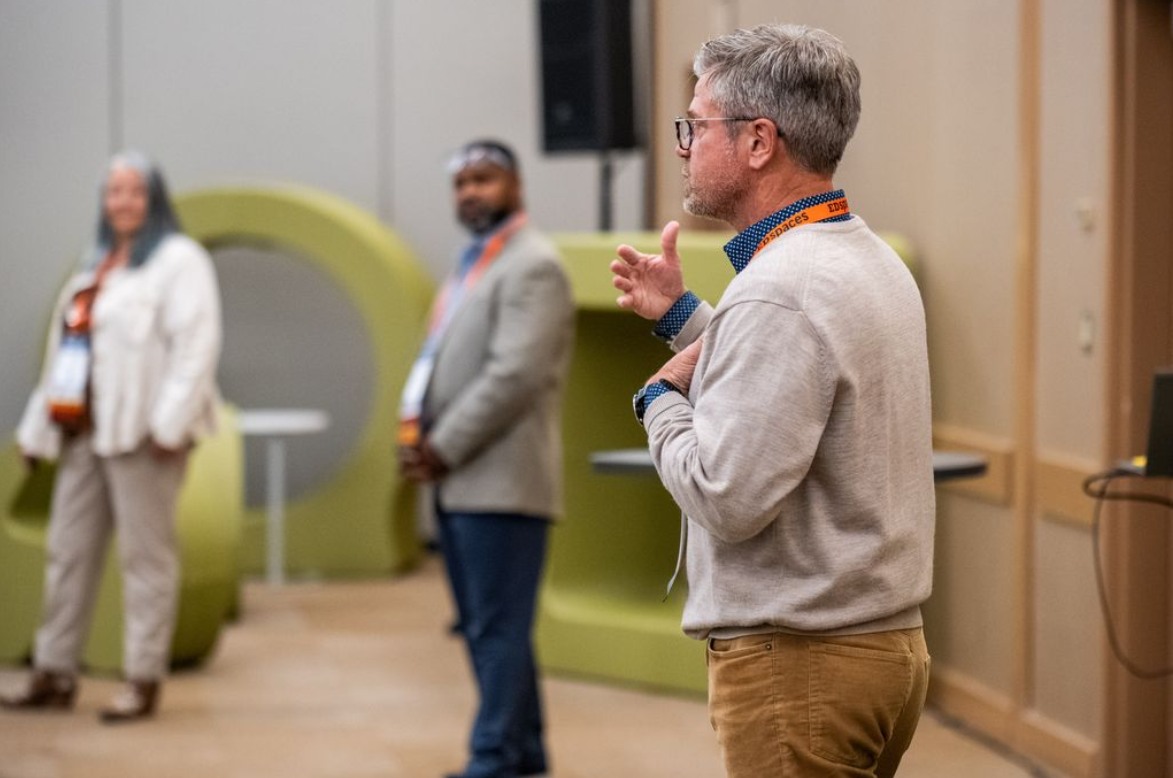
EDspaces education sessions are held in unique classrooms designed by your peers. These spaces give speakers the opportunity to model authentic teaching and learning and demonstrate real-world application of cutting-edge products.
Review/Selection Process
The Education Advisory Group, comprised of recognized industry leaders as well as representatives from EDspaces partner organizations, will review all complete submissions to recommend which are selected. Reviewers will evaluate proposals based on several criteria:
- Alignment with Theme & Track
- Learning Value & Takeaways
- Credibility, Evidence & Experience
- Human Experience, Safety & Equity
- Collaboration & Perspective
- Engagement & Session Design
- Educational Perspective Bonus — To reinforce EDspaces’ commitment to authentic, practitioner-led insight, proposals may earn up to 15 additional points for including an active educational practitioner as part of the presenting team.
Submission Guidance
Submissions are due by March 31.
There is no submission fee, but all speakers selected to present must register for the conference and will receive a 50% reduced registration rate on the applicable registration category in recognition of their contribution to the education program. Each speaker, including all co-speakers, must agree to allow Emerald to use their name and likeness and presentation in print, audio/video or electronic format.
Successful proposals will:
- Clearly identify a problem, opportunity, or emerging need.
- Demonstrate real-world applications, implementation, or evidence and offer practical insights attendees can apply.
- Involve the educator’s perspective to add credibility, performance, and reference to the sessions. (Extra points are applied to educator-led or sessions or panels with educators represented.)
- Reflect collaboration across roles, including educational, design, and facilities perspectives.
- Be clear and concise in your description and identify four learning objectives that satisfy AIA, LEED, and/or NCIDQ accreditation requirements. If submitting a Health, Safety, and Welfare (HSW) topic (highly sought after), be sure at least three of the four Learning Objectives address the HSW requirement.
- Design your presentation to encourage audience interaction by using methods and tools such as facilitated delivery with high participation, peer-to-peer components, small-group discussions, etc.