

Future-ready schools are designed to evolve over time. They support multiple teaching styles, encourage collaboration, promote student well-being, and allow educators to reconfigure spaces as learning needs shift throughout the day. Increasingly, school leaders and facility planners are recognizing that physical environments are not separate from instruction—they actively shape it.
Flexibility as a Core Design Principle
For many districts, flexibility has become one of the defining characteristics of a future-ready campus. Traditional classrooms were often designed around a single instructional model: rows of desks facing the front of the room. Today’s classrooms, however, may need to support lecture-based instruction, collaborative projects, small-group discussions, independent learning, and technology integration—all within the same class period.

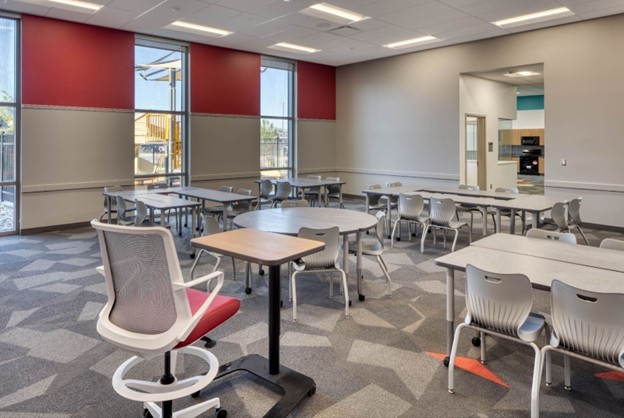
That reality is influencing everything from room layouts to furniture selection. Classrooms are now being designed to transition easily between different teaching and learning modes. Mobile tables, stackable seating, and movable podiums gave teachers the ability to quickly rearrange spaces depending on instructional goals. Rather than treating furniture as static infrastructure, school leaders approach it as an active component of the learning environment. In some ways furniture is transforming into an instructional tool, not just a simple desk or chair.
For facility managers and procurement professionals, this shift also raises practical considerations. Flexible furnishings may reduce the need for future renovations by allowing spaces to adapt over time. In districts experiencing enrollment changes or programmatic change, that adaptability can offer long-term value.
Beyond the Classroom: Informal Learning Spaces Matter
Future-ready schools are increasingly designed around the idea that learning happens everywhere—not only inside traditional classrooms. Libraries, commons areas, hallways, and learning suites are being reimagined as spaces where students can gather, study, collaborate, or recharge throughout the day. These environments often serve multiple purposes simultaneously, supporting both academic work and social interaction. Lounge seating, collaborative tables, and soft seating areas can create a range of environments suited to different learning preferences and energy levels.
This approach reflects a broader trend in K–12 design. Students today are accustomed to varied environments and greater autonomy in how they work. Schools that provide a mix of quiet spaces, collaborative zones, and flexible commons areas can better accommodate diverse learning styles and student needs.
For school leaders, these spaces also present an opportunity to strengthen school culture. Informal gathering areas can foster peer interaction, encourage mentoring relationships, and create a stronger sense of belonging within large campuses.
Supporting the Whole Student
Another defining feature of future-ready schools is the growing emphasis on student well-being.
Over the last decade, educators have become increasingly aware that academic success is closely connected to physical, emotional, and social support systems. As a result, many new school projects now incorporate wellness-focused spaces into the overall campus design.
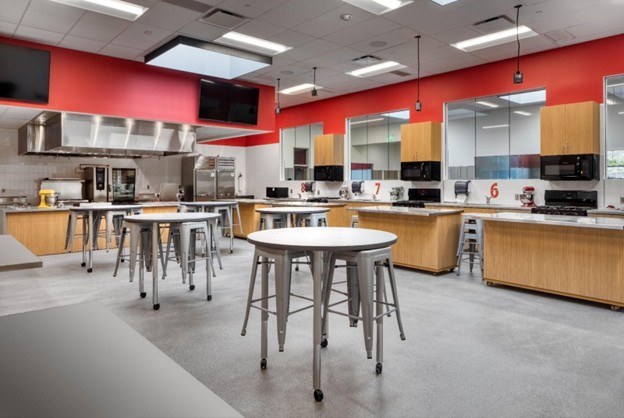
Many district leaders are prioritizing student support through the creation of teen centers where students can access food, clothing, laundry facilities, and restorative spaces. These centers reflect a whole-child approach to education—one that recognizes students learn best when basic needs are met and when they feel safe and supported. Importantly, these spaces are not designed as isolated service areas hidden from the rest of the school community. Instead, they are integrated into the campus environment in ways that promote dignity, inclusion, and connection.
Comfortable furnishings, calming environments, and flexible layouts can contribute to spaces that feel welcoming rather than institutional. Increasingly, districts are evaluating school environments not only for durability and efficiency, but also for their ability to support student wellness and engagement.
Planning for Long-Term Adaptability
One of the biggest challenges facing K–12 districts is uncertainty. Enrollment patterns change. Instructional priorities evolve. Technology advances quickly. Schools built today must remain functional and relevant for decades. That reality is pushing districts toward more adaptable design strategies.
Future-ready schools are not necessarily defined by cutting-edge technology or dramatic architecture. In many cases, they succeed because they are intentionally versatile. Spaces can be reconfigured without major renovation. Furnishings can move and scale with changing needs. Shared environments can support both academic and community functions.
For procurement professionals, this often means evaluating products and layouts through a longer-term lens. Durability remains important, but adaptability and multi-functionality are becoming equally critical considerations.
The experience at Deseret Peak High School, a school just outside of Salt Lake City, illustrates how thoughtful planning can help districts align facilities with evolving educational goals. While every community has different needs, the broader lesson is increasingly clear: the physical environment plays a meaningful role in how students learn, connect, and thrive.
As districts continue to navigate growth, staffing challenges, changing instructional models, and student wellness concerns, the future-ready school may ultimately be less about predicting what education will become—and more about creating spaces capable of evolving alongside it.
The construction of Deseret Peak High School was driven by a vision to create a future-ready learning environment. Situated within a rapidly growing community west of Salt Lake City, the district sought to foster next-generation education while addressing the everyday needs of an expanding student population. To bring this vision to life, the district worked with The HON Company to create a flexible, student-centered environment grounded in adaptability and well-being.
With growing enrollment, Deseret Peak required classrooms that could easily shift between disciplines, teaching styles, and learning modes. HON furnished classrooms with mobile tables, stackable chairs, and caster-based podiums, granting students and educators the ability to seamlessly transition between group work, full-class discussion, and independent study.
Attention was also paid to supporting connection and informal learning throughout the school. Common areas, libraries, and learning suites were outfitted with lounge seating, collaborative tables, and comfortable soft seating to create welcoming spaces that encourage interaction, concentrated learning, and peer engagement. By incorporating comfortable, flexible furnishings, students are empowered to choose the environments that best support their focus, while providing educators with casual spaces that can enhance teaching and community-building.
 Leslie Stebbins is the director of Research4Ed. She has more than twenty-five years of experience in higher education and K-12 learning and instructional design. Her clients include Harvard University, the U.S. Department of Education, Tufts University, and the Gates Foundation. She has an M.Ed. from the Technology Innovation & Education Program at the Harvard Graduate School of Education and a Master’s in Library and Information Science from Simmons College.