
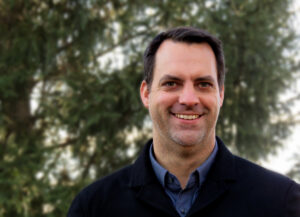
Exploring innovation and flexibility drive the designs Carnegie Mellon University’s assistant professor of architecture and track co-chair for architecture-engineering-construction management
Q; How did you first fall in love with the built environment?
A: When I was in upper elementary, our small church decided to build a new sanctuary and I witnessed how an architect can help a community negotiate and realize their collective vision. I then had the good fortune of taking several high school drafting courses with Jerry Krieger, who helped me imagine a career as an architect.
Q: Is there an example of architecture that especially compels you?
A: The SCSD (School Construction System Development) project still fascinates me, even after studying it for several years. It built on the lessons learned from CLASP and other flexible building systems by using performance specifications to drive component innovation and is an early example of what we now call Open Building. It also is one of the first projects I know of that included a post-occupancy evaluation.
Q: What enticed you to move your architectural expertise into the educational realm?
A: My first architectural internship was working for the University of Michigan’s Facilities Planning and Development where I first learned about the impact space planning can have on teaching and research. My wife, Bridget Kiger-Lee, is an educational psychologist and her research focuses on active learning strategies, so with the opportunity to work for SHW Group’s Higher Education Studio, now Stantec, I was excited to explore the linkages between spatial flexibility and shifting pedagogies.
Q: How do you hope to see educational design transform for the better?
A: The pandemic has raised serious questions about the future of education facilities. I would have never imagined that remote, asynchronous learning could be successful, but I witnessed my two children work fairly independently and grow despite the rapid, ad hoc move to online pedagogy. We have also collectively witnessed how fast spatial change can happen in educational facilities when there is the public will to do so. The pandemic highlighted the extreme environmental inequalities between school districts. I hope we can continue to move toward wellness for all schools with better air filtration and ventilation, access to windows and daylight, sustainable materials, community services, and adaptable facilities that provide widespread access to learning opportunities outside the traditional classroom.
Q: Can you talk about an aspect of the Carnegie Mellon curriculum that has you excited?
A: CMU SoA has recently made a concerted effort to address pedagogical and environmental injustices through our teaching, research, and service. We have a strong group of student leaders who are working with our faculty to address these issues in every course we teach. The profession of architecture and allied disciplines have much to offer and we are preparing our students to work on these challenges.
Q: The Carnegie Mellon architecture-engineering-construction management program is top-notch. Why does it stand out?
A: I am the track chair for the MS and PhD in AECM, which is jointly offered with our Department of Civil and Environmental Engineering. Our students come from all over the world with a diverse array of backgrounds and career objectives, so our class discussions are always rich with insight and healthy conflict. AECM focuses on the managerial and financial aspects of architectural practice, an essential aspect that is largely ignored in many architectural programs.
Q: How important do you think play is to educational design?
A: As I mentioned earlier, I have the good fortune of being married to an educational psychologist and her research and recent book, Drama-based Pedagogy, are focused on active learning so we frequently discuss this. I’m also a parent and have seen the benefits of play-based instruction in our children’s education firsthand. Sufficient storage space, flexible furniture, and durable activity zones that permit a bit of messiness are helpful.
Q: You have an interest in adaptable architecture. How are you seeing this manifest in the educational sphere?
A: In my mind, adaptable architecture is an approach to sustainable design. The early sustainable design movement promoted durability, which seems logical in terms of decreased environmental footprint. However, change is inevitable in every educational setting. Pedagogy a century ago, 50 years ago, 10 years ago, and before the pandemic, are significantly different from how we will teach in the near and distant future. I hope we learn from our recent experience with the pandemic and prepare for uncertainty by designing with the principles of spatial flexibility, metabolism, cradle to cradle, circular economy, open building, resiliency, adaptive reuse, and design for deconstruction. We also need to study how these principles have worked in practice to continue to improve our ability to respond to change sustainably.
Q: Construction is often overlooked when discussing design. Your dissertation and book shine a light on this aspect though. Can you share something eye-opening that you uncovered during your research?
A: The SCSD was successful in driving innovation among educational component manufacturers. Generally speaking the system performed very well technically. The modularity of the system was well-coordinated, the components held up well, and the various components could be moved relatively easily. What didn’t work particularly well was the social side of the system. Introducing innovative structures, furniture, partition systems, etc. without directly consulting the intended users, providing training and instructions for repair and replacement, or maintaining records and sufficient backstock, is a recipe for failure.
Q: Outside of teaching, what type of research/project would you like to pursue next?
A: I am working with a number of firms and nonprofits on open building and deconstruction research. We are putting together case studies of exemplary projects and trying to figure out how to close material loops through reuse. I’m also currently working with a nonprofit in Liberia to create a series of buildings for their campus that can be easily adapted to a variety of uses with earth block construction and enhanced natural ventilation.